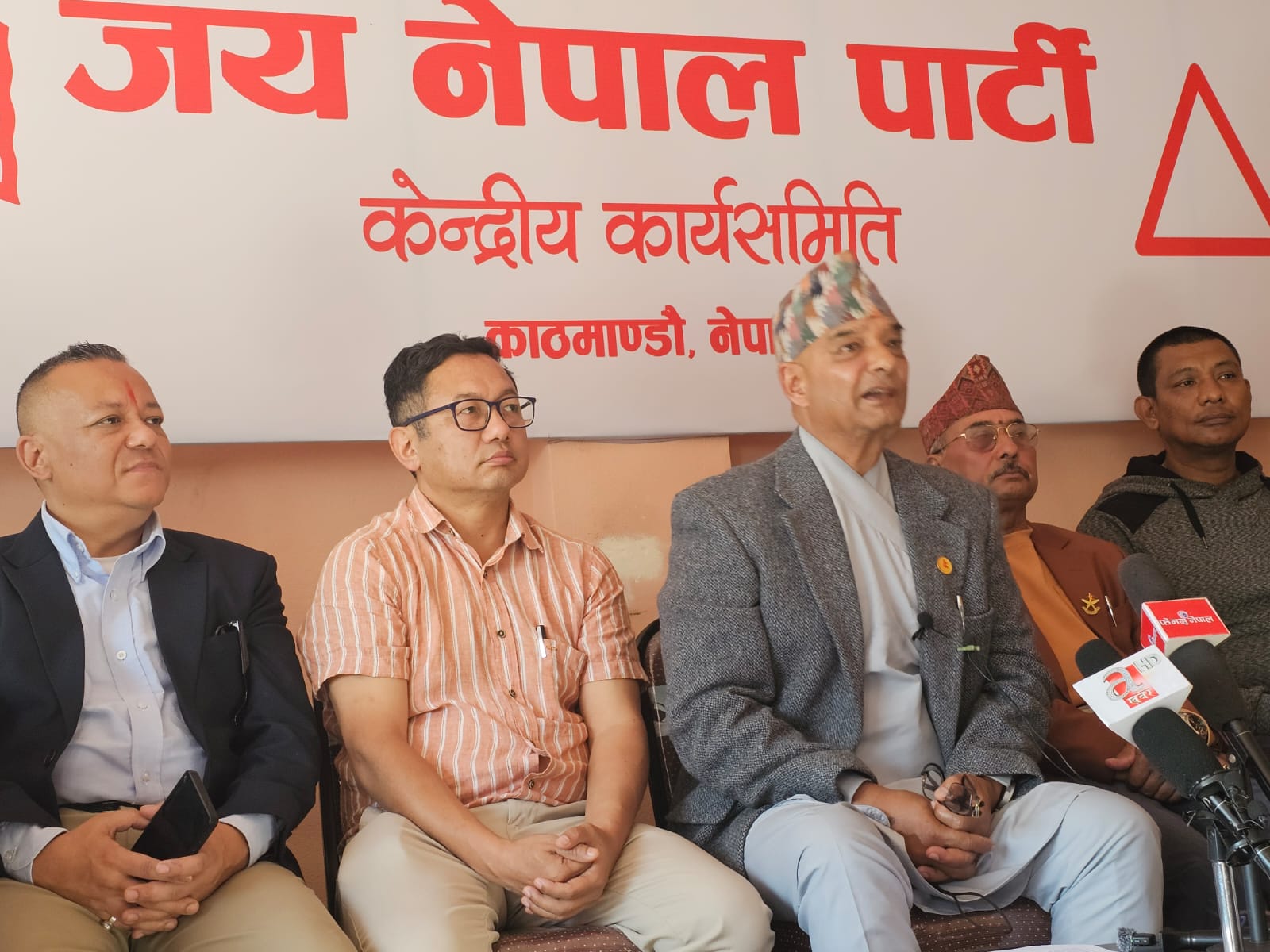
The Jaya Nepal Party has unveiled an eight-point resolution, including proposals for constitutional amendments, and said that it will launch a series of phased protests if its demands are not addressed.
In a statement issued on Tuesday, party Chairman Dhawal Shumsher Rana said that constitutional amendments should prioritize issues including nationalism, democracy, constitutional monarchy, and religious identity.
"We have vowed to carry out peaceful protest activities in phases if the state fails to address these priorities in a timely manner," he said.
The party accused the government led by Balen Shah of failing to establish a credible foundation for good governance, prosperity, and corruption control.
It criticized the government for failing to deliver justice to young people, security personnel, and other citizens who lost their lives during the Gen Z uprising, as well as for failing to bring to justice those responsible for setting government buildings and structures on fire.
The party also demanded the publication of details regarding relief materials and funds provided to areas affected by the Bhotekoshi-Trishuli flood on August 26.
It urged the government to release updated information on where and how the money collected in the Prime Minister’s Disaster Relief Fund had been spent and to provide details on progress in rehabilitation and reconstruction.
The party also expressed concern over what it described as a doubling or tripling of prices of daily essentials, worsening living conditions for ordinary citizens, and an increase in arrests of citizens, including journalists, without warrants. The statement said that such practices violated the rule of law and democratic values.
Here are the party’s eight-point resolution for constitutional amendments:
1. Constitutional amendment for robust nationalism and meaningful democracy.
2. Control of soaring market prices and inflation.
3. A Sanatan Hindu kindgom – including Hindu, Buddhist, and Kirat traditions – with a constitutional monarchy.
4. Ban on religious conversion, cow slaughter, and the sale of beef.
5. Youth- and women-friendly economic development and a prosperous Nepal driven by technology.
6. Justice for victims of cooperatives and microfinance institutions.
7. Referendum on empowered local bodies and the provincial structure.
8. Guarantee of voting rights under the principle of "Once a Nepali, always a Nepali."