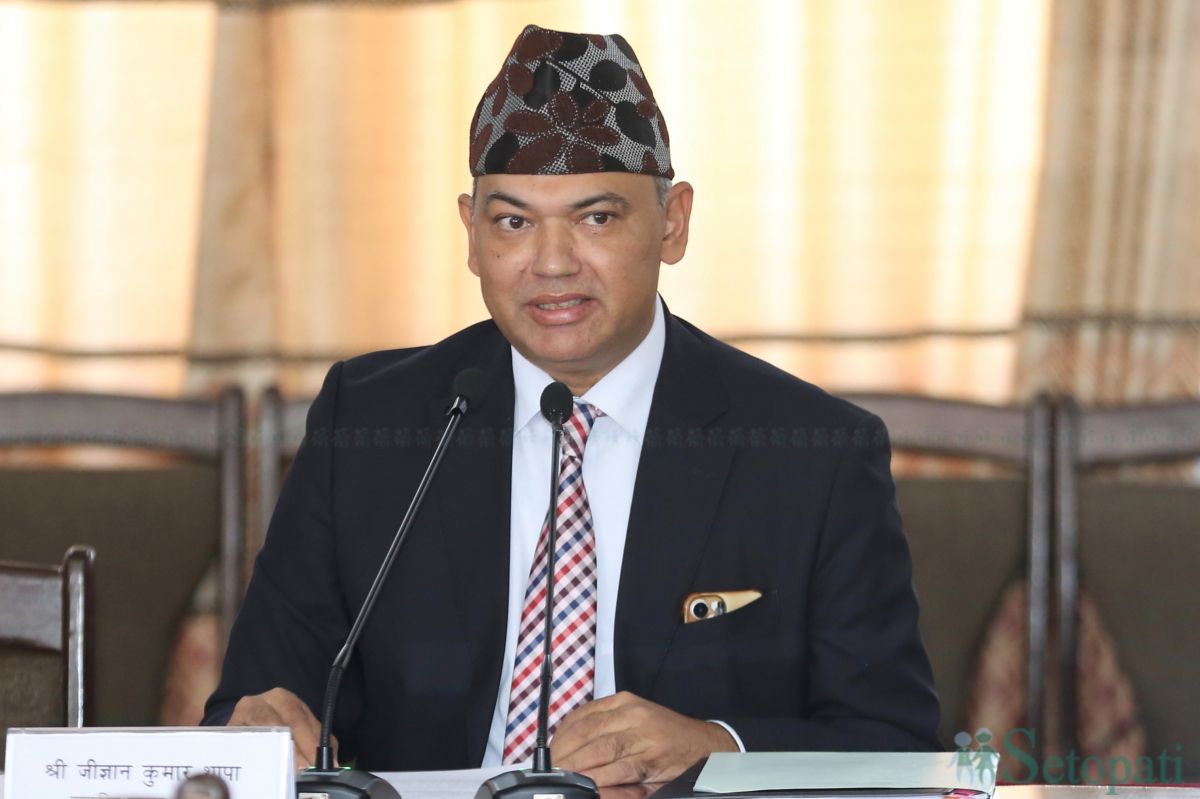
The Parliamentary Hearing Committee, which has put on hold its decision on the nomination of Jigyan Kumar Thapa as Nepal’s ambassador to Japan, has sought additional information about him.
Through the Ministry of Foreign Affairs, the committee has requested details from the Nepali Embassy in Japan regarding whether Thapa has renounced his permanent residency status in Japan and whether he received salary or other benefits from the Japanese government.
Thapa presented his work plan to the Parliamentary Hearing Committee on October 14 and subsequently answered questions from lawmakers. However, the committee has withheld approval of his nomination.
Before approving his name, the committee wants to resolve two issues.
The first concerns whether Thapa has relinquished his permanent residency status in Japan. The committee had previously sought information on this matter from the Nepali embassy in Japan through the Ministry of Foreign Affairs.
The second concerns whether he received salary or other benefits from Japanese government funds. On October 26, the committee sent another letter requesting detailed clarification on the matter.
The Ministry of Foreign Affairs’ criteria for ambassadorial appointments stipulate that a person who has received salary or benefits from a foreign government cannot be appointed ambassador until 10 years have elapsed since receiving such remuneration.
The committee has sought details on whether Thapa received any salary or other benefits from Japanese government funds while working as a public policy and municipal affairs specialist in Kanagawa International Foundation, Japan International Cooperation,.
The committee has yet to receive a response from the Ministry of Foreign Affairs.
Two issues raised during hearing
Two major issues were raised about Thapa during his parliamentary hearing.
The first concerns his permanent residency status in Japan.
Under Article 291 of Nepal’s Constitution, a Nepali citizen who has obtained a foreign country’s permanent residency permit is not eligible to become an ambassador. However, the provision allows such a person to be elected, nominated, or appointed to the position once at least three months have elapsed since renouncing that status.
Thapa told the Parliamentary Hearing Committee that he had already relinquished his permanent residency status in Japan. As evidence, he submitted documents officially translated by Bishwa Bhasa Campus.
The translated documents state that his name has been removed from Japan’s resident card records.
According to the translated information, Thapa obtained resident status on November 15, 2020. His resident card was removed from the records on March 25, 2026. The Kanagawa Ward Office in Yokohama, Japan, provided the information confirming the removal of his resident card record.
However, questions have arisen over whether he met the eligibility requirements when he applied for the ambassadorial position.
On May 28, the Ministry of Foreign Affairs invited applications and recommendations for ambassadorial positions through an open competition. The deadline for submitting applications was June 5.
Based on these dates, Thapa appears to have applied for the position before the constitutionally mandated three-month period had elapsed. In other words, he was constitutionally eligible for the position at the time of application.
By the time the Cabinet decided to appoint him, however, more than three months had passed since he relinquished his permanent residency status. The Cabinet made the appointment decision on September 18.
Appointing someone who did not meet the constitutional eligibility requirements when applying could invite legal challenges in the future. The Parliamentary Hearing Committee is treating the matter seriously.
The second question concerns a potential conflict of interest.
Thapa lived in Japan for nearly 25 years. During his parliamentary hearing, he acknowledged that he had returned to Nepal specifically to become an ambassador.
Thapa owns a house in Japan. His wife and children hold permanent residency status there. He also transferred property registered in his name to his wife’s name in order to become an ambassador.
Lawmakers have raised concerns that sending him back to Japan as Nepal’s ambassador under these circumstances could create a conflict of interest.
Some lawmakers argued that it would be inappropriate to appoint someone who had lived in Japan for many years and returned to Nepal only recently as Nepal’s ambassador to Japan.
There are also differing views within the Rastriya Swatantra Party (RSP) on whether Thapa’s nomination should be approved.
RSP lawmakers Rajeev Khatri and Madhu Kumar Chaulagain, among others on the Parliamentary Hearing Committee, opposed approving his nomination. However, RSP Chief Whip Kabindra Burlakoti proposed deferring the decision for some time.
Thapa asked to withdraw name, seeks time
According to sources on the Parliamentary Hearing Committee, lawmakers had almost reached a consensus to reject the nominations of both Thapa, proposed for Japan, and Giri Bahadur Sunar, proposed for Saudi Arabia, during a training program for committee members held in Chandragiri.
By that point, committee members had already reviewed complaints filed against the nominees.
Sources said that after Thapa’s hearing concluded on October 14, the committee held a closed-door discussion on whether to approve or reject his nomination.
Following the discussion, Thapa was reportedly informed that he could withdraw his nomination; otherwise, the committee would reject it.
Thapa, however, requested some time.
At a subsequent meeting, committee chair Bodh Narayan Shrestha put Thapa’s nomination on hold following a proposal from RSP Chief Whip Burlakoti.
The committee, however, unanimously rejected the nominations of Giri Bahadur Sunar for Saudi Arabia and Chudamani Kharel for Malaysia.
Decision required by November 6
The date of the next Parliamentary Hearing Committee meeting to decide on Thapa’s nomination has not yet been confirmed.
Committee chair Shrestha is preparing to convene a meeting after receiving a response from the Ministry of Foreign Affairs.
Under the regulations governing joint meetings of the Federal Parliament, the Parliamentary Hearing Committee must complete the hearing process within 45 days. If the committee fails to make a decision within that period, the government may proceed with the ambassadorial appointment.
The Office of the Prime Minister and Council of Ministers wrote to the Federal Parliament Secretariat on September 23, requesting that the hearing process be initiated.
Based on this timeline, the committee must decide on Thapa’s nomination within the next 10 days.
Thirty-five days have elapsed since the ambassadorial nomination process was initiated. The committee must complete the hearing and inform the Office of the Prime Minister and Council of Ministers by November 6.