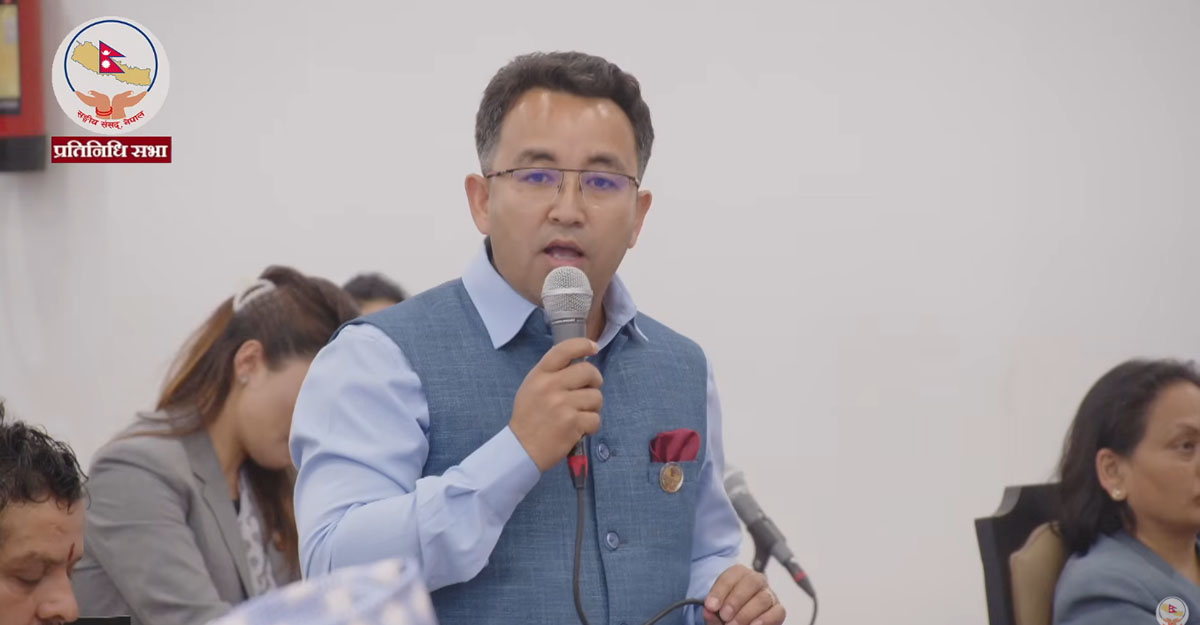
Deputy leader of the Rastriya Swatantra Party (RSP) parliamentary party, Ganesh Parajuli, is set to become chairman of the parliamentary special committee on the Bhotekoshi-Trishuli disaster, after he emerged as the sole candidate for the post.
Parajuli’s candidacy has been supported by lawmakers from all parties represented in the House of Representatives. Nepali Congress lawmaker Mohan Acharya has proposed his candidacy.
His supporters include Pushpa Raj Kandel of the CPN-UML, Ramesh Kumar Malla of the Nepali Communist Party, Dhruba Raj Rai of the Shram Sanskriti Party, Saraswati Lama of the Rastriya Prajatantra Party, and Nisha Dangi of the RSP.
On September 21, Speaker Dol Prasad Aryal had presented a proposal in the House to form the “Parliamentary Special Committee on the Impact of Climate Change in the Himalayas, Climate Justice, and the Bhotekoshi-Trishuli Disaster.”
The 15-member committee, formed under Rule 180 of the House of Representatives Regulations, 2026, is tasked with studying the Bhotekoshi-Trishuli disaster and recommending measures to be taken by the state for the rehabilitation of affected citizens, sustainable reconstruction, future risk reduction, necessary legal and institutional reforms, and climate justice.
The committee will have a three-month tenure from the date of its first meeting.
The committee will study the impacts of climate change in the Himalayan region, as well as changes in glaciers, glacial lakes, and watersheds and the risks arising from those changes. It has also been mandated to conduct an expert- and scientifically based study on the origin, sequence of events, immediate causes, and risk-amplifying factors associated with the Bhotekoshi-Trishuli disaster.
It will also examine the possible links to climate change, transboundary watersheds impacts, and the effects on downstream areas.
The committee will assess search and rescue operations, relief efforts, and rehabilitation following the disaster. It will review the status of missing citizens, relief distribution, safe temporary accommodation, basic services, and livelihood recovery, and recommend immediate and medium-term measures for improvement.
For reconstruction of damaged housing, roads, bridges, energy facilities, drinking-water systems, irrigation infrastructure, and other public infrastructure, the committee will recommend a roadmap covering risk assessment, selection of safe locations, technical standards, priorities, financial resources, and timelines. Monitoring the quality, transparency, and progress of reconstruction is also part of its mandate.
The committee will also recommend measures for multi-hazard risk mapping, development of safe settlements, protection of vulnerable infrastructure, and community preparedness. It has also been tasked with preparing a framework for strengthening early-warning systems, ranging from monitoring glacial lakes, rivers, rainfall, and landslides to delivering warnings to communities and facilitating safe relocation.
The committee will study issues related to carbon emissions, climate justice, and loss and damage. Its mandate includes recommending mechanisms for documenting losses and damages suffered by affected citizens, improving access to climate finance, and establishing the basis for Nepal to present its claims and positions at international forums.
It will also suggest ways to strengthen bilateral, regional, and multilateral cooperation on Himalayan conservation, adaptation, financial and technical assistance, joint research, and cross-border risk-information sharing.
The committee may review laws related to disaster management, the environment, climate change, land use, infrastructure safety, and protection of affected citizens, and recommend legislative initiatives for necessary amendments or new legislation.
It will recommend ways to clarify responsibilities, resource mobilization, and implementation-related coordination among the three tiers of government and relevant agencies. It will also conduct parliamentary oversight of government decisions, programs, budgets, and progress related to disaster management and reconstruction.
The committee will obtain information from relevant agencies, consult experts and officials, receive suggestions from affected citizens, and conduct field studies when necessary.
The committee is required to submit within three months a report to the House of Representatives covering its findings, issues that need to be addressed immediately, a sustainable reconstruction roadmap, legal and institutional reforms, and climate justice and diplomatic priorities. The report must also identify responsible agencies, timelines, required resources, and monitoring indicators for implementing its recommendations.
15-member committee
The committee includes Ganesh Parajuli, Achyutam Lamichhane, Anushka Shrestha, Ganga Devi Shrestha, Dhananjay Regmi, Dhruba Raj Rai, Nisha Dangi, Pushpa Raj Kandel, Mohan Acharya, Mingma Gyabu Sherpa, Ramesh Kumar Malla, Rabindra Patel, Saraswati Lama, Sujata Tamang, and Sita Thapaliya.
Parajuli previously chaired the committee that drafted the House of Representatives Regulations, 2026. A writ petition was filed at the Supreme Court challenging provisions of the regulations related to constitutional amendments. The Supreme Court has issued an interim order halting implementation of those provisions.