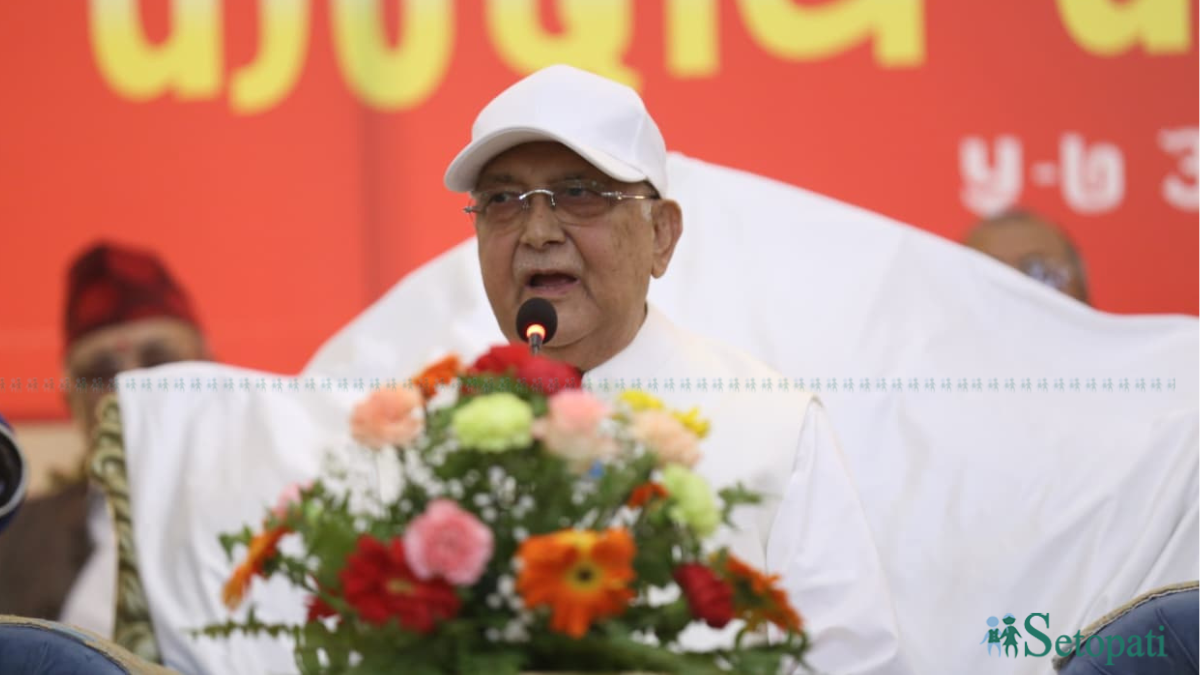
CPN-UML Chairman KP Sharma Oli has included his views on transformation, transfer and generational transition in his political report presented at the party’s central committee meeting.
Stating that the three terms – transformation, transfer and generational transition – have been heard frequently, Oli said that all three are necessary, but stressed that they must be understood in their proper sense.
“Transformation does not mean erasing history. It does not mean rejecting or insulting the party’s struggle, ideology, sacrifices, and organizational traditions. Transformation means changing our working style, changing the language we use when speaking to the people, making the decision-making process more streamlined, transforming committees from formal structures that hold meetings into centers for solving people’s problems, and transforming leadership from a level that gives orders into one that listens, understands, and delivers results,” Oli said. “To produce a new sprout on an old tree, the roots are not cut. The roots are nourished to grow new sprouts. The history of the UML is the root, and the new generation is the new sprout,” he said.
Oli said that the transfer of leadership is not an abrupt or arbitrary act of vacating a position, but rather the planned transfer of responsibility, knowledge, experience, institutions, political culture, and decision-making capacity.
“Transfer without institutional preparation can create a vacuum. Generational transition is not merely the arithmetic of age. It is a process of giving the new generation responsibility, training, experience, opportunities, and a place in decision-making. Being young does not by itself constitute qualification, just as being older does not by itself constitute disqualification. A combination of energy and experience is necessary,” Oli said. “Therefore, transformation should be made the language of renaissance, not of instability. Transfer is not fear; it is institutional maturity. Generational transition is not division; it is continuity,” he said.
Oli also said that some people within the party have been calling for the chairman to pave the way for a leadership change.
“At this time, some individuals have been playing untimely tunes with the intention and efforts of removing the chairman, and slogans of reorganization have been raised for that purpose. What is reorganization? Under what circumstances does it take place? Is removing the leadership called reorganization? We need to properly understand how many times and under what circumstances reorganization has taken place in the history of our movement,” he said. “Party reorganization is not a matter of whim or impulse. It is an action undertaken out of necessity in difficult and abnormal circumstances,” Oli said.
He also said that if the question of leadership is mixed up with competition from “bourgeois, right-wing or vacuous populist anti-party forces,” the party would cease to remain a revolutionary party.
“It would no longer be a cadre-based party, but merely a status-quoist mass party. Attempts are being made to push us in that direction on the issues of party building and leadership,” he said.
Regarding the party’s two immediate major tasks, Oli noted that mere review and analysis would no longer be sufficient and that a concrete program for reconstruction and renaissance is required.