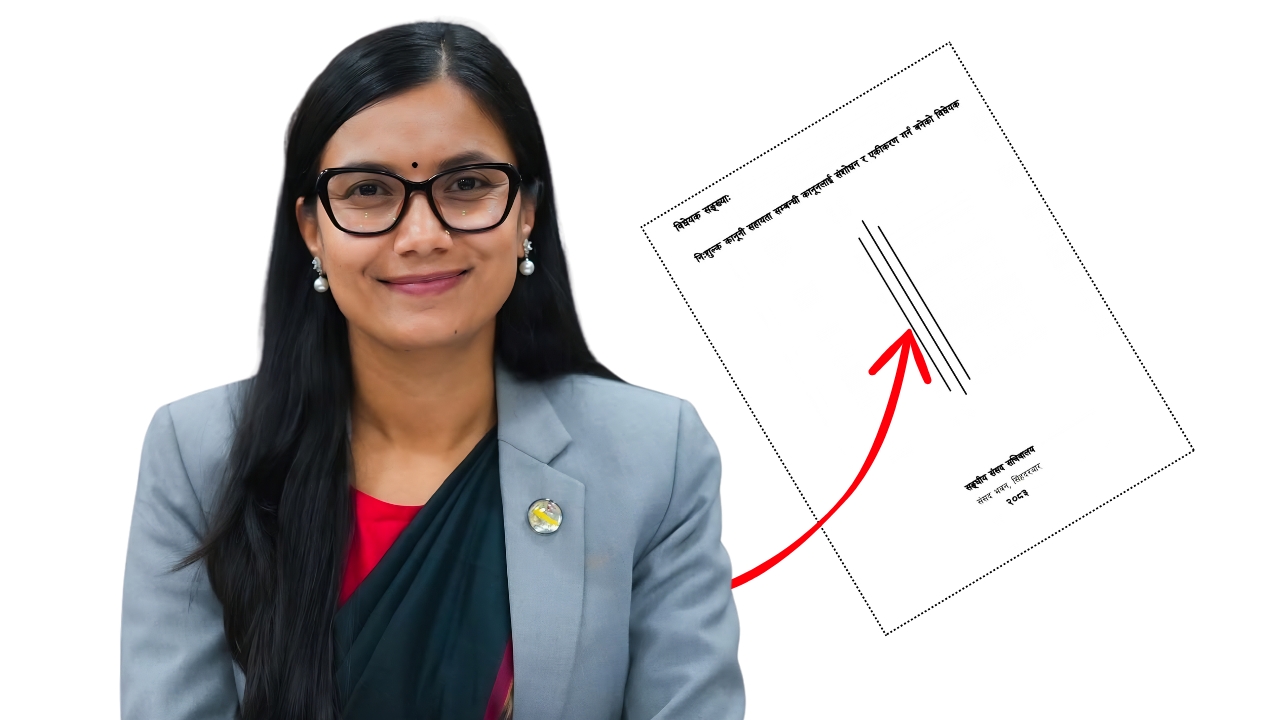
The government has registered a bill in the House of Representatives that seeks to broaden the scope of people eligible for free legal aid.
The existing Legal Aid Act 1997 provides legal assistance to individuals whose annual income is below a prescribed threshold, as well as to victims of gender-based violence or armed conflict.
The Free Legal Aid Bill registered in the House of Representatives by Law Minister Sobita Gautam proposes to provide free legal assistance to citizens from various groups and communities.
Under the bill, children, senior citizens, persons with disabilities, helpless individuals, and women who are socially or educationally disadvantaged will be entitled to free legal aid.
Similarly, Dalits, indigenous nationalities, Tharus, minorities, marginalized communities, Muslims, disadvantaged groups, and gender and sexual minorities will also be eligible for such assistance.
Impoverished Khas Arya people, workers, farmers, people from oppressed or backward regions, and economically disadvantaged citizens will also qualify for free legal aid.
The bill also proposes free legal assistance to victims of domestic or gender-based violence, martyrs and victims of armed conflict, people injured in various movements, and those injured in the Gen Z movement. Victims of caste-based and other forms of social untouchability and discrimination will also be eligible for such assistance.
A person arrested in a criminal case will also be entitled to free legal aid if they inform authorities at the time of arrest that they are unable to afford a lawyer. The bill also includes provisions for free legal assistance to detainees and prisoners. Additionally, parties to cases for whom the court orders free legal aid will also receive such assistance.
People seeking such assistance will have to submit an application through their local government or to the District Legal Aid Committee. The committee will be headed by the district judge.
Applicants will also have to submit a self-declaration stating that they are unable to afford a lawyer, along with a recommendation from their local government. For example, if a person is arrested on a criminal charge, they will have to submit a self-declaration of their inability to afford a lawyer and a recommendation from the investigating officer.
The bill also allows such applications to be submitted online. It further provides that people eligible for free legal aid will not have to pay court fees if they state that they are unable to pay them immediately.
The bill also provides for access to expert lawyers when legal aid is provided. Some recipients of legal aid have complained that they lost cases because they were represented by inexperienced or less capable lawyers. The bill seeks to address such concerns by allowing expert lawyers in the relevant field to provide legal assistance.
“If, due to the subject matter and legal complexity of a case in which free legal aid is being provided, written preparation and representation before the court are required from a lawyer specializing in the relevant subject, the district committee may decide to provide such free legal aid through an expert lawyer in that field,” the bill states.
For the first time, the bill also provides for psychosocial counseling services. People who approach authorities seeking free legal aid will be eligible for psychosocial counseling, with the district committee responsible for preparing a list of service providers.
The bill appears to have introduced several progressive provisions. For example, when providing free legal aid to persons with disabilities, sign language will also have to be used where necessary.
The bill also allows local governments to provide financial assistance to people who require legal aid but cannot afford the cost of traveling between their local government and the district headquarters. Such assistance may cover transportation, accommodation, and food expenses.
The bill also introduces a provision allowing lawyers to voluntarily provide legal assistance on a pro bono basis. Pro bono refers to legal services provided free of charge as a form of voluntary assistance.
District committees will maintain a roster of lawyers willing to provide free legal aid. Lawyers providing such assistance will be required to submit details of their work to the district committee every three months.
Lawmakers in the House of Representatives’ Law, Justice and Human Rights Committee have also argued that pro bono services should be made mandatory for senior advocates. They have said that experienced senior advocates have been reluctant to provide free legal assistance and have argued that making such services mandatory could address the issue.
Once passed by the House of Representatives, the bill will proceed to the National Assembly. It will become law after being passed by the National Assembly and authenticated by the president.