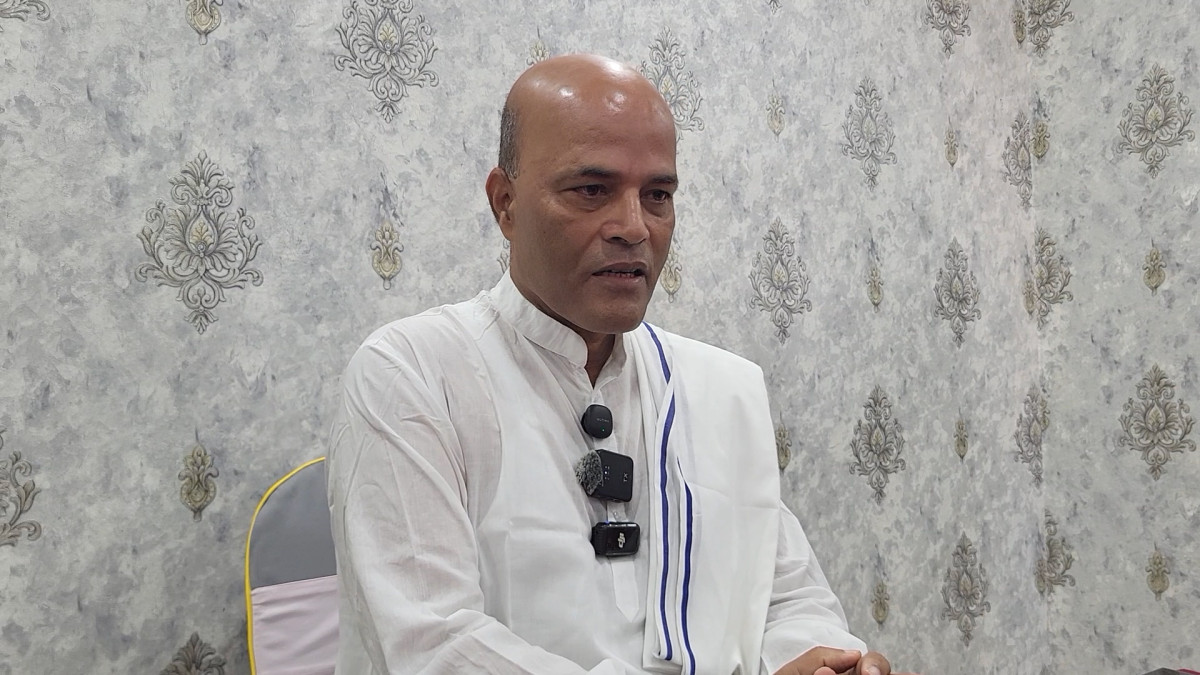
Lawmaker Amresh Kumar Singh of the ruling Rastriya Swatantra Party (RSP) has said that Madhesh should not be turned into a battleground for conflict by dividing people along the lines of caste, religion, geography, or politics.
Speaking to journalists in Janakpur on Sunday, Singh said that politics from now on should focus on bringing society together, maintaining unity, and promoting economic prosperity. “Our path now must be the path of unity and prosperity,” he said.
Singh announced that after offering arghya at Ganga Sagar in Janakpur on the occasion of the Chhath festival and visiting the Janaki Temple, he will begin the Mechi–Mahakali foot march from Bhadrapur in Jhapa. According to him, the journey will be undertaken on foot, not by vehicle or chariot. He said that the march aims to engage in direct dialogue with the people and listen to their problems.
He said that he plans to visit villages and neighborhoods, hold discussions with local residents, speak less himself and listen more to the people. Rather than organizing stages and delivering speeches, he intends to focus on hearing about local problems, he added.
Singh said that during the march, he would discuss with local residents issues including youth migration abroad, foreign employment, problems faced by farmers and workers, difficulties faced by traders, and the reasons why the Madhesh economy has been unable to gain momentum.
He said that the march would address problems faced by people living in border areas, cross-border trade, family and social ties across the border, and security-related issues.
Singh said that education, health, roads, irrigation, peace and security, and sanitation should be prioritized for the development of Madhesh.
He said that the quality of schools in Madhesh needs to be improved and that government hospitals and specialist health services need to be expanded. He argued that government-run super-specialty services are necessary for treating complex diseases such as heart disease, kidney disease, and cancer. Stating that Madhesh lacks sufficient government medical, engineering, and agriculture colleges, he called for the expansion of such educational institutions.
Singh said that roads and irrigation should also be prioritized for the development of Madhesh. He said that the Postal Highway has not yet been fully completed and that there are problems with bridge and infrastructure construction in areas including the Kamala and Bagmati rivers.
Stating that adequate irrigation has not reached the fields in Madhesh, Singh said Koshi’s water should be effectively delivered to Saptari and Siraha and Gandak’s water to Bara, Parsa, and Rautahat.
Singh questioned the practice of spending large amounts on beautification of ponds while failing to give sufficient attention to improving the physical infrastructure of schools and hospitals. He said that development does not mean merely constructing concrete structures and argued that plans should take local needs and environmental impacts into account.
Singh said that the objective of the Madhesh Movement was not merely to have certain issues incorporated into the Constitution or create political leadership, but also to ensure economic development, political participation, and equal opportunities.
He said that Kathmandu alone should not be blamed for the current state of Madhesh, arguing that the political leadership and local governments in Madhesh must also review their own shortcomings.
(News Agency Nepal)