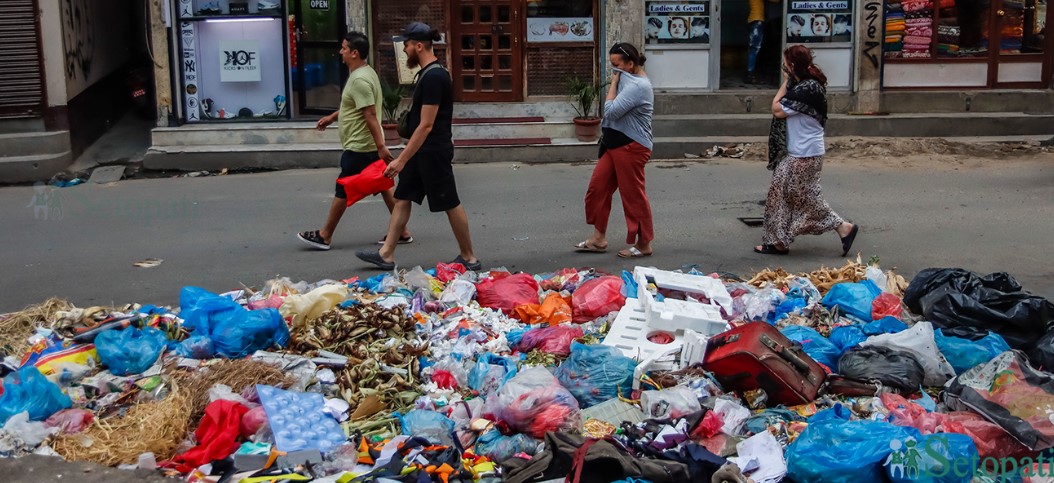
The government has introduced a bill proposing penalties for people who litter in public places.
The bill, registered in Parliament, proposes fines ranging from Rs 5,000 to Rs 15,000 for people who throw waste indiscriminately instead of placing it in dustbins provided in public spaces.
The bill requires local governments to install covered dustbins, as needed, at locations including public roads, public parks, exhibition venues, public transport facilities, and bus stops within their jurisdictions designated through notices published in the local gazette for waste collection.
Separate dustbins will have to be provided for biodegradable, non-biodegradable, and hazardous waste. If dustbins have not already been installed, local governments will be required to install them within three months of the law coming into force.
The bill, registered in the House of Representatives by Minister for Infrastructure Development Sunil Lamsal, proposes a fine of Rs 5,000 for a first offense of failing to dispose of waste in a dustbin, Rs 5,000 to Rs 10,000 for a second offense, and Rs 15,000 for a third or subsequent offense. Offenders would also have to pay the cost of collecting the waste.
The bill authorizes local governments to impose these fines.
It also proposes fines ranging from Rs 15,000 to Rs 50,000, along with recovery of the cost of replacing or managing dustbins, for vandalizing, damaging, removing, or destroying dustbins installed in public places.
Anyone who dumps, places, or accumulates harmful substances in or around a dustbin or designated waste collection area would face a fine of Rs 5,000 to Rs 15,000 and would be required to compensate for any resulting damage.
Similarly, individuals who dispose of mixed biodegradable and non-biodegradable waste without separating it would be fined Rs 500 for each offense. In the case of an organization, the proposed fine is Rs 50,000 for each offense.
The bill, aimed at amending and consolidating laws related to waste management, proposes a fine of Rs 5,000 to Rs 15,000 for placing, burying, dumping, stockpiling, or burning household or compound waste on roads or in public places.
The same fine would apply to anyone who discharges leachate or sewage in a manner that pollutes another person’s house, compound or land, or obstructs a public road.
A fine of Rs 5,000 to Rs 15,000 would also be imposed for throwing or stockpiling dead or slaughtered animals, animal manure, feathers, bones, or fish scales in public places, on roads, or in alleys.
Anyone who leaves a vehicle parked or refuses to move it when a waste collection vehicle arrives to collect waste would face a fine of Rs 1,000 to Rs 5,000.
Similarly, dumping or disposing of hazardous waste at public or sensitive locations, other than designated sites, in a manner that poses a risk to public health would attract a fine of Rs 30,000 to Rs 50,000.
The bill also requires individuals, groups, and organizations that put up posters, pamphlets, leaflets, wall writings, flags, or similar materials during public events to remove them after the event. Failure to do so would result in a fine ranging from Rs 50,000 to Rs 200,000.
The bill gives the chief district officer the authority to punish anyone who obstructs waste collection, transportation, management, or disposal operations in any manner.
The chief district officer may impose a fine of Rs 10,000 to Rs 50,000 or imprisonment for 15 days to three months on anyone who obstructs waste collection or transportation.