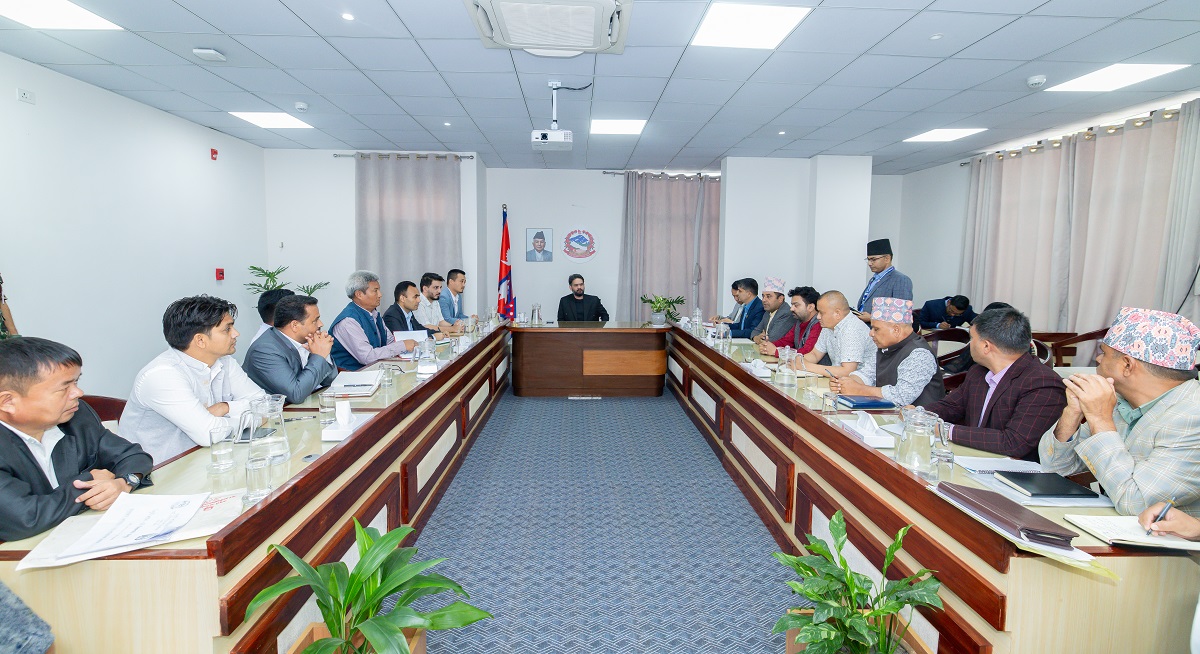
Prime Minister Balen Shah has held discussions with the heads of local governments from districts affected by the Bhotekoshi-Trishuli flood.
The meeting took place at the Office of the Prime Minister and Council of Ministers on Monday from 11 a.m. to 2:30 p.m.
During the meeting, PM Shah held discussions with the heads of local governments from the flood-affected areas of Rasuwa, Nuwakot, Dhading, Tanahun, and Gorkha districts.
The discussions focused on the rehabilitation of settlements in areas affected by the flooding that entered the Trishuli River through the Bhotekoshi River from the Tibet region.
According to the prime minister’s secretariat, PM Shah said that all three levels of government had stood together in response to the disaster.
“Earlier, we used to hear that there was no coordination among the federal, provincial, and local levels. But in this disaster, we stood together and worked collectively,” PM Shah said.
Shukra Chuman, chairman of Tanahun’s Aanbu Khaireni Rural Municipality, said that the local government chiefs presented the problems facing their respective municipalities to the prime minister.
Chuman said that he raised concerns over the difficulties caused by the lack of an alternative route to the Narayanghat-Muglin road. He also highlighted the potential risks his municipality faces in the future because it lies along the Marsyangdi, Seti, and Trishuli rivers.
He also informed the prime minister that four people from the municipality had gone missing in the flood.
“The prime minister said that all three tiers of government can work together to provide relief and carry out resettlement, and that we can face the disaster without panic,” Chairman Chuman told Setopati.
Nuwakot’s Bidur Municipality is among the areas hardest hit by the flood.
Bidur Mayor Rajan Shrestha said that he prioritized the issue of rehabilitation before the prime minister, informing him about potential alternative locations to house those displaced by the flood.
PM Shah assured them that since local representatives are more familiar with the geography, the central government would ensure that there is no shortage of budget, Shrestha said.
“‘You are very familiar with the situation and the geography. You know what needs to be built, how much money is required, and even about possible donor assistance. We expect this information from you. To address necessary matters, we will not let funds fall short and will manage them from wherever possible,” Shrestha quoted the prime minister as saying.
Shrestha said that he also proposed alternative locations for relocating locals from flood-hit areas affected by the disaster without affecting their emotional, historical, and cultural values.
“Local people may have emotional attachments, and there are also historical and cultural aspects involved. I proposed that they be resettled in nearby locations without affecting these ties, with the locations selected and protected through legislation,” he said. “I proposed developing the area under a smart-city concept through land pooling.”
He said that he proposed establishing Tribhuvan Trishuli Secondary School, which has 1,600 students, as a mega school with residential facilities.
According to Shrestha, he also proposed that the federal government pass legislation allowing land exchanges to provide safe settlements for flood-affected families.
Bidur Municipality has begun the process of managing displaced residents under its “Room to Home” initiative.
The federal government has decided to provide Rs 15,000 to each affected family for temporary accommodation.
The municipality has also offered Rs 10,000 and asked families to move into rented rooms. It has distributed essential supplies, including gas cylinders, cooking utensils, and food, to families who have moved into rented accommodation.
“Resettlement could take a year to a year and a half. So, for now, we have asked people to stay in rented rooms, while we work to create an environment where they can eventually live in permanent buildings,” he said. “There are approximately 1,710 families. Some families have already moved into rented rooms based on assurances. We will hold an all-party meeting at the local level, endorse the plan, and take further decisions.”
The municipality also presented the prime minister with proposals for relocating affected families to various locations.
According to Shrestha, one proposal is to acquire land at Suhara Danda to resettle residents of Betrawati.
He said that a proposal was also made to resettle displaced families from Tuchche, Sipitar, Akare, and Polani in Bhitrinitar, using land owned by an authority there.
For some houses located at Number 1 Bridge in Ward No. 10, the municipality proposed relocating residents to the ward office in Dekhutar.
For residents of Trishuli-Dhunge, the municipality proposed using land belonging to the Nepal Electricity Authority in Ward No. 9.
Similarly, the municipality plans to relocate residents of Tinchaur in Ward No. 4 to Dhapkhet in Ward No. 2, and displaced residents of Devighat in Ward No. 5 to Chandrayoti playground near the Ayurveda Hospital.
“The prime minister has assured us that the will enact the necessary legislation. It may not be safe to put local residents back in the same places, and we do not want to take that risk. Apparently, preparations are also underway to establish an authority for post-disaster resettlement. Various studies are also being conducted,” he said.
Home Minister Sudan Gurung, Infrastructure Minister Sunil Lamsal, and Communications and Information Minister Bikram Timilsina were also present at the meeting.
They said that their respective ministries would provide the necessary support for the required work.
Belkotgadhi Municipality Mayor Jagat Bahadur Gurung, Kispang Rural Municipality Chairman Birbal Tamang, and Tarakeshwar Rural Municipality Chairman Shiva Adhikari also participated in the discussions.
Similarly, Rasuwa’s Uttar Gaya Rural Municipality Chairman Madhav Prasad Aryal, Kalika Rural Municipality Chairman Hari Krishna Devkota, and Aamachhodingmo Rural Municipality Chairman Buchung Tamang attended the meeting.
However, Gosainkunda Rural Municipality Chairman Kaisang Nurbu Tamang, whose municipality was among the first areas hit by the flood, did not attend the meeting.