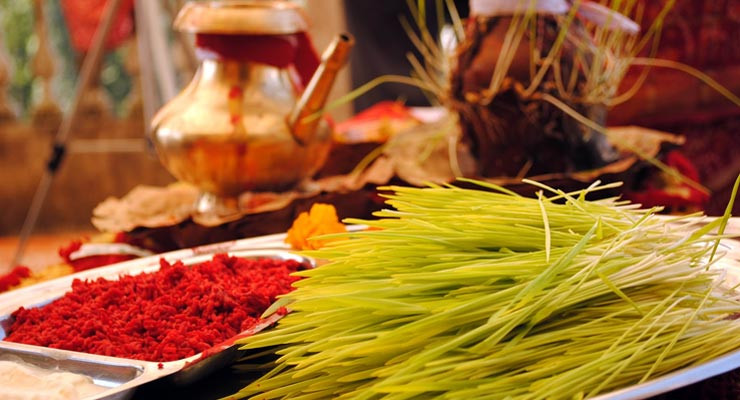
Every year, as Dashain approaches, Nepal transforms. Bamboo swings appear in villages, shops fill with new clothes, bus tickets vanish, and families prepare for the journey home. Photographs of red tika-covered foreheads and green jamara fill our social media feeds. For many, it is the most familiar season of the year: childhood, reunion, belonging.
I have watched this nostalgia unfold for as long as I can remember. Yet, coming from a family in Madhesh, I have never quite experienced Dashain the way it is so often described.
We did not play rote pings or gather around card games. We did not grow jamara at home or line up with foreheads covered in red tika. Dashain arrived every year, but not as the festival I saw portrayed around me.
For a long time I never thought about this. It was simply how we lived. But somewhere along the way I began to wonder why a festival I had not grown up celebrating in this way could still stir nostalgia in me. Why did I feel I was missing something that had never been part of my childhood?
Perhaps the answer lies not in religion, but in how culture shapes our sense of belonging.
I am Hindu, as are millions across Nepal’s hills, mountains, and plains. Yet our Hinduism does not always look the same. Families, communities, and histories shape how we worship, which festivals we observe, what we cook, and what we remember. A shared religion does not guarantee a shared cultural experience.
The problem begins when one cultural experience becomes the default against which everyone else’s is measured.
Dashain is undoubtedly a major festival, tied to Goddess Durga and to traditions of reunion and blessing. But the familiar image of jamara, red tika, village swings, and journeys home does not describe every Hindu household. I speak only of my own family and those like it; many Madheshi families celebrate Dashain in exactly that way. In Madhesh, the cultural calendar has its own rhythms. Chhath carries deep significance, particularly in Mithila, where worship, music, food, and collective participation are woven into community life. Durga Puja and Dashami have their own expressions. Even the names differ; Dashain, Dashami, Durga Puja, Dussehra, overlapping but not interchangeable.
Our public conversation, however, tends to present the most visible practice as everyone’s natural experience. Here a harmless celebration raises a larger question about what I will call social engineering. I use the term analytically, not to suggest a coordinated plan. Cultural expectations rarely arrive as orders. They spread through repetition: the same images in advertisements, television programs, school activities, and public messages. The same rituals become shorthand for national culture. Over time, what is most visible begins to feel universal, while what is different needs explaining.
Scholars have long examined how dominant norms acquire the appearance of common sense. In Nepal, Krishna Prasad Pandey’s 2024 study of Madheshi identity examines the tension between a formally multi-ethnic, multilingual nation and the pressure to fit a dominant national cultural framework.
This does not mean Dashain is exclusively a hill festival, nor that everyone who celebrates it is participating in domination. That would be historically simplistic and unfair to the many communities that have made the festival their own. Traditions travel and acquire new meanings. People adopt customs because they find joy, faith, or community in them.
The question is not whether cultural exchange should happen. It is whether participation should become the measure of belonging.
Consider the quiet pressure in an ordinary question: “Dashain ma tika lagauna jaanu bhayena?” Usually it is innocent. But repeated across years, such questions can turn an unfamiliar custom into an assumed obligation. Someone who has never celebrated that way may begin to feel they missed a shared national experience, rather than simply grew up with a different one.
The consequences extend beyond festivals. When one way of speaking, dressing, worshiping, or remembering is treated as the national norm, other ways of living become less visible. Communities find themselves explaining their practices, defending their identities, or adapting their public expressions to fit expectations never designed around them. Madhesh knows this struggle for recognition. Its languages, histories, and traditions have often had to compete for space in national conversations. Recognizing this is not an invitation to reverse the hierarchy or build a different monopoly. It is a call to question the hierarchy itself.
I do not want Dashain to become less joyful for anyone. I understand why people return home, why they wait for the tika of their elders, and why the sight of jamara can carry them back to childhood. There is something deeply human in preserving the rituals through which families remember one another.
But I also want the freedom to appreciate that joy without pretending it is my own memory.
Perhaps the nostalgia I feel is not for a festival I once celebrated and lost. Perhaps it is for the possibility of a country in which I do not have to share every cultural experience to feel that I belong. A festival can be national without being culturally uniform. A religion can be shared without being practiced identically.
This Dashain, I will watch the swings, the journeys home, and the photographs of tika with the same affection I have always felt. I will recognize the happiness they bring. But I will also remember that my childhood was not incomplete because it looked different.
Not every nostalgia is inherited. Sometimes it is manufactured by the world around us. And sometimes the most important act of belonging is to acknowledge that we were never all meant to remember the same things.