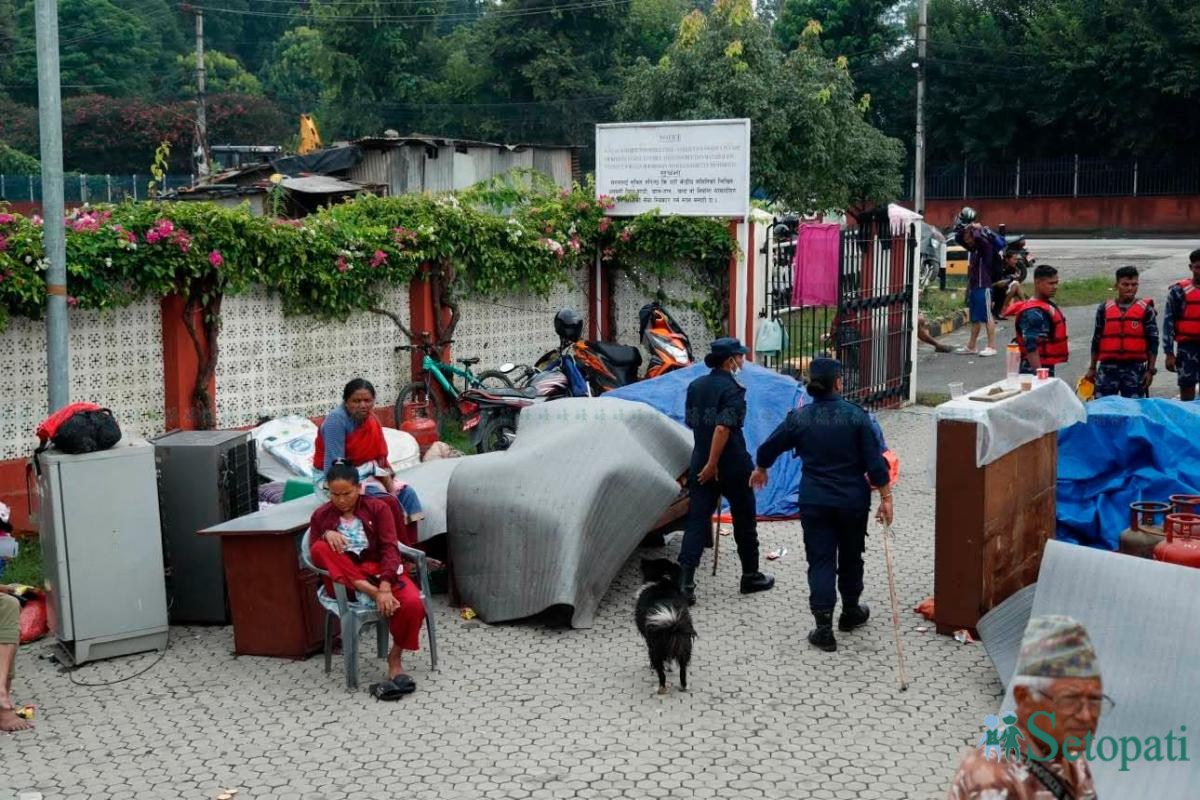
While verifying families displaced from the riverbanks of the Kathmandu Valley, the Land Problems Resolution Committee has found that about 70 percent are genuine landless squatters.
The committee has started investigating whether members of the landless families kept in various holding centers own any land or property.
So far, records of 160 families have been examined, and 109 families have been confirmed as having no land or property anywhere in the country, according to committee spokesperson Amir Prasad Neupane.
It remains to be determined whether the land found registered in the names of the remaining 51 families is arable or habitable. Currently, Land Revenue Office records only show houses and land in their names. Practically, all of that land may not be suitable for farming or living.
Land located in the hills might be at risk of landslides, while land in the Terai could be affected by flooding. Landslides and floods are among the various reasons why people become landless.
Officials say that while the records of land and property have been found, their practical aspects are yet to be ascertained.
"We have sent the details to the district committees of the respective places where land and property were found, and they will look into the rest," said spokesperson Neupane. "We have also sent the details of those who do not own any land or property to their respective permanent addresses. The relevant district committee will also make arrangements for them."
According to Neupane, the High Powered Committee for Integrated Development of Bagmati Civilization had sent the details of 388 families staying in various holding centers to check whether their members owned houses or land. Among them, the details of 160 families have been examined so far.
"We will continue to remove the names of families found with houses and land from the list of squatters," he said.
The Land Act also has provisions for legal action against those who pretend to be landless by submitting false details. According to the Act, those who intentionally submit false details may be fined up to Rs 25,000.
Those who have already acquired land based on false details may face a fine of up to Rs 100,000, imprisonment for up to one year, and confiscation of the land obtained through false declarations.
Officials who issue false recommendations or verification reports also face a fine of up to Rs 25,000.
In the Kathmandu Valley, the names of over 2,600 families living along the riverbanks were recorded in the initial phase. Among them, only 2,000 families have contacted authorities. Out of those, the details of only 388 families reached the Land Problems Resolution Committee after completing all the procedures, said spokesperson Neupane.
"Of the cases that have reached us, investigation has been completed for 160 families, while the rest are in the process," Neupane said.
The state has adopted a policy to resettle only genuine landless Dalits and squatters living in risky areas such as riverbanks or in settlements that violate standards.
For informal settlers, those who have been residing in a location since before February 11, 2010, may be allowed to remain there if the area is deemed suitable for habitation. Those living in unsuitable locations, however, will have to vacate the land. The committee said that the state will not provide land to them elsewhere.